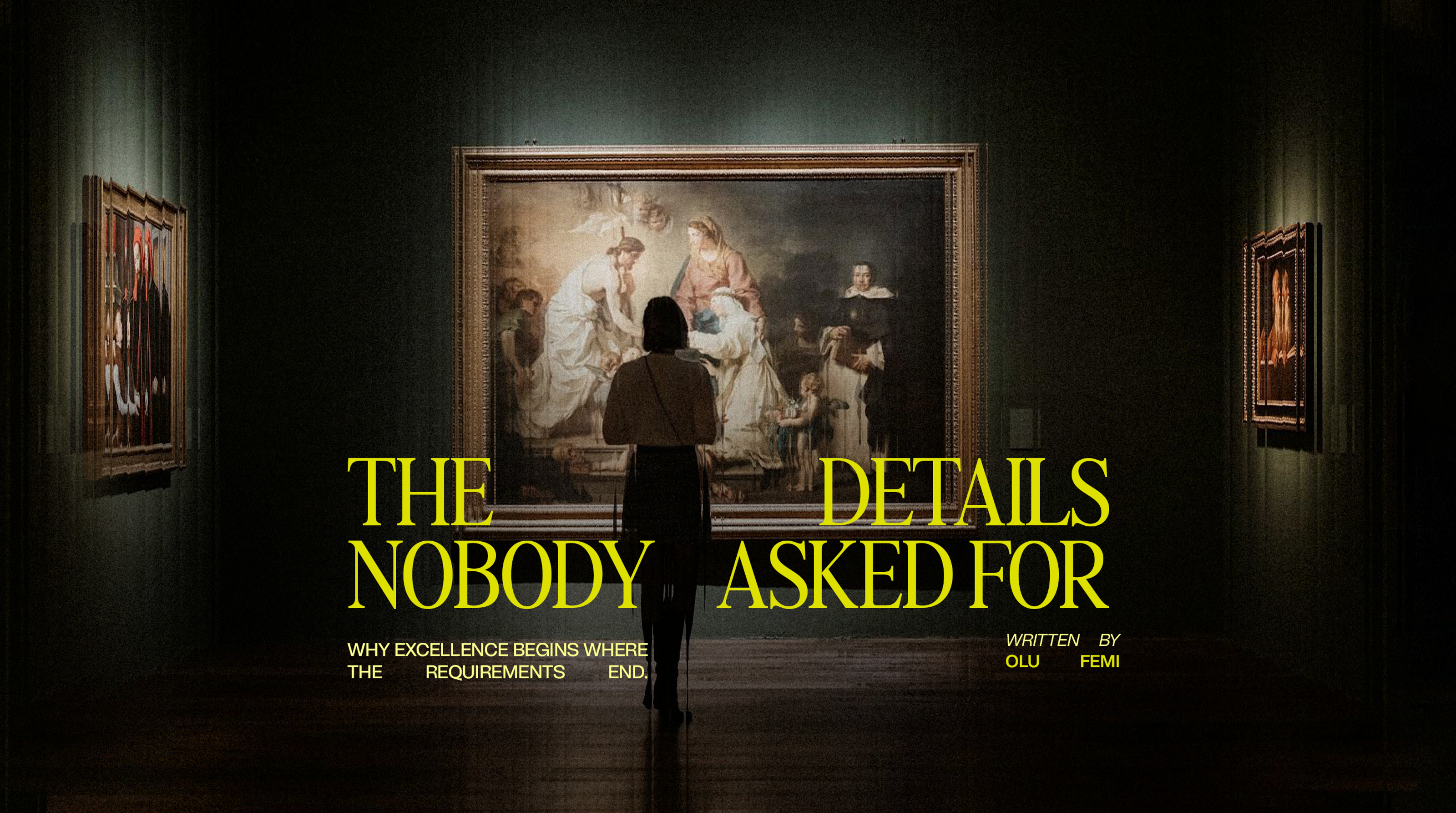
The Details Nobody Asked For
Why excellence begins where the requirements end.
I think there is a strange moment that happens when you have been doing something long enough. You stop being satisfied by simply getting it right.
I have caught myself in this place more times than I can count. The work is technically finished. Everything that was requested is there. The deadline is still intact. If I sent it out right then, nobody would probably complain. In fact, they might tell me it looks great.
And yet, I am still sitting there staring at the screen.
I move something by a few pixels. I adjust a shadow. I change the spacing between two elements. I look at a reflection that nobody else would probably notice and decide it could be better. Sometimes I close the project entirely, walk away, make a cup of coffee and come back to it with fresh eyes.
Then I do it again.
I have often wondered why I do this. There is no extra line on the invoice for it. Nobody asked me to spend another thirty minutes making something slightly better. There is no applause waiting at the end of it.
Sometimes, I am not even sure the person receiving the work will notice.
But I will.
And maybe that is the point.
I have been thinking a lot about the difference between doing something well and really caring about how it is done. They sound like the same thing until you experience the difference.
Two people can spend seven hours working on the same project and produce completely different results. One person can spend those seven hours completing everything that was required. Another can spend the same seven hours questioning everything that could be improved.
The difference is not necessarily effort.
It is attention.
It is the willingness to look at something that is already good and ask, "Can this feel better?"
I think that is where craftsmanship begins.
There is a level you eventually have to take your craft to where your work starts separating itself from the work of someone who simply decided to learn the same skill. Not because you are more talented, and not necessarily because you have spent more years doing it, but because you have developed a different relationship with the details.
You start noticing things.
The way light falls across a product.
The tiny inconsistency in a layout.
The way a piece of packaging feels when you hold it.
The difference between something that is finished and something that feels finished.
Those things are difficult to teach because they are not always written down. They come from paying attention for a very long time.
I think about this whenever I see something that feels genuinely premium.
It is rarely one dramatic thing that makes it feel that way. It is usually a collection of small decisions.
The packaging feels a little heavier. The typography sits exactly where it should. The material has a texture you did not expect. The box opens in a particular way. The photograph has just enough space around the subject. The product sits perfectly inside the frame.
None of these things are particularly revolutionary on their own.
But together, they create a feeling.
Someone cared.
That is what I think premium really is.
Not necessarily expensive materials. Not unnecessary decoration. Not trying to make something look luxurious.
Just an accumulation of decisions that communicate a level of care.
And I think this applies far beyond creative work.
There is a furniture maker who sands the underside of a table even though nobody will probably ever see it. There is a chef who wipes the edge of a plate before it leaves the kitchen. There is a tailor who spends another ten minutes making sure a stitch sits perfectly straight. There is a writer who rewrites a sentence five times because the fifth version says what the first four could not.
Nobody asked for those things.
That is precisely why they matter.
The requirements tell you what needs to be done. Your standards determine how far you take it.
I have started thinking that this might be one of the most important differences between people who are good at something and people who become exceptional at it.
At some point, you have to stop measuring your growth only by how much you know.
You have to start measuring it by what you are no longer willing to overlook.
The beginner sees the obvious problem.
The experienced person sees the subtle one.
The craftsman sees the thing that is not technically wrong but still does not feel right.
That last part is difficult because there is no checklist for it.
You cannot always explain why something feels off. You just know that it does.
And sometimes you have to trust that feeling enough to go back and try again.
I think we underestimate how much of excellence is made up of these moments.
The extra hour nobody sees.
The fifth version that never gets published.
The photograph you reshoot because the first one was good but not quite there.
The presentation you rethink even though the client probably would have accepted the original.
The decision to learn one more thing when you could have stopped learning years ago.
These things do not always make you more productive.
Sometimes they make you slower.
But perhaps not all slowness is inefficiency.
Sometimes it is care.
We live in a world that constantly encourages us to finish. Finish the course. Finish the project. Finish the book. Finish the next thing. Move on.
There is value in that.
But there is also something to be said for staying with one thing long enough to discover what it could become.
Maybe that is why some work feels different.
You can sense when someone was simply trying to finish.
You can also sense when someone stayed a little longer.
I have started to believe that the things that make your work memorable are often the things nobody specifically asked you to do.
They are the details that existed only because you cared enough to put them there.
And over time, those details begin to compound.
One becomes your taste.
Another becomes your standard.
The standard becomes your reputation.
Eventually, people start recognising your work before they recognise your name.
That is the part I find most interesting.
Your craft eventually becomes a record of what you care about.
It reveals what you notice.
It reveals what you refuse to compromise on.
It reveals how long you are willing to stay with something after everyone else has decided it is finished.
Maybe that is why I keep going back to that export button.
Maybe I am not really trying to make the work perfect.
Maybe I am trying to make it feel like I could not have left it any other way.
The brief tells you what to make.
Your standards decide what it becomes.
And perhaps excellence begins in that small space between the two.
The space where nobody is asking for more.
The space where nobody is watching.
The space where you have to decide for yourself whether good enough is actually enough.
Those are the details nobody asked for.
And I think, eventually, they become the ones people remember.